Physical Address
304 North Cardinal St.
Dorchester Center, MA 02124
Physical Address
304 North Cardinal St.
Dorchester Center, MA 02124

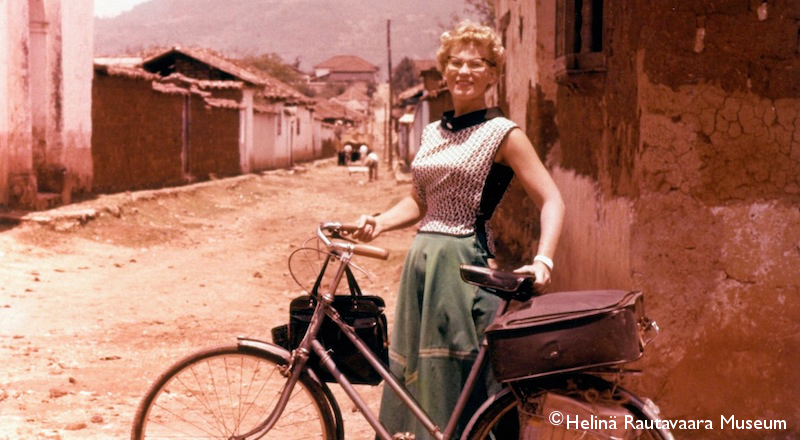
Believe it or not, I’m not the first Finnish female to cycle alone through Latin America in the discovery of local cultures. It has been done before me, but the crazy thing is that the last and only time a Finnish woman did it was nearly 60 years ago. Imagine, as if the whole journey wasn’t already full of challenges these days, Helinä Rautavaara did it in times before asphalt roads, mobile phones or waterproof Ortlieb panniers.
The strange thing about Helinä Rautavaara (1928–1998) is that her past is actually incredibly similar to my own. Our stories overlap so strongly that even though I never got the chance to meet her before she passed away, I feel like I’d known her. She was an explorer, a scholar, an adventuress – a truly enthusiastic, inspirational and curious human being.
I first heard about Helinä Rautavaara around ten years ago, upon my virgin visit to the Helinä Rautavaara Museum. My mother took me there, and I have to confess I was nowhere near thrilled about visiting some old granny’s personal recollections from her trips. Yet, opposite to my prejudices, the museum turned out to be the most interesting ethnographic museum I’ve ever seen on the face of earth. I was struck by the fact that one person could have had such a multifaceted life with such varied experiences, and not just that, that she had had the vision and the will to share it with the rest of us. I am still continuously fascinated by the stories from Helinä’s cycling and hitchhiking trips around the Middle East, Africa, Latin America and Southern Asia, among others.
Helinä Rautavaara’s life is so full of colorful events that it’s impossible to depict them all in a single blog post. So, rather than a thorough biography, I want to provide you with an overview on who this lady was and what kind of things she did during her lifetime. To me, she’s a true idol, an inspiration, a kindred spirit. That’s why I collaborate with the ethnographic museum which not only carries her name but was funded by her in 1998.
Helinä Rautavaara was born in Helsinki, Finland, in the year 1928. Her mother was an interpreter and stenographer and her father a professor, who used to travel a lot due to his international career. As a Master of Arts, Helinä dedicated her whole life to the documentation of cultures and religions. In 1950s, after graduating from the university, she traveled as a journalist to numerous destinations outside Europe. The people of Finland learned about these travels to Northern Africa, the Middle East and to Southern Asia through her colorful articles on the magazine Seura. From the materials collected abroad, Helinä also compiled her first radio and tv programs.
During her stays on the different continents, Helinä created an important contact network thanks to her good education, presentation skills and Finland’s reputation as a neutral country. On her long stays in Latin America and Africa, she collected data for her doctoral thesis. Although Helinä never finished the thesis, she learned a great deal about the destinations and used much of this information as the basis of her museum project. Thanks to these sojourns abroad, as well as due to the way Helinä dressed and decorated her house, Finns knew her as a very extravagant connoisseur of Latin America, the Caribbean and Africa.
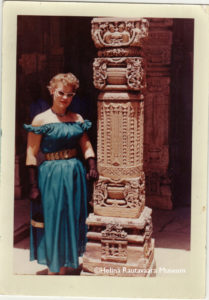
 In the year 1948 Helinä graduated from SYK (a prestigious high-school in Helsinki) and on the same year she attended an international peace camp in Stockholm, Sweden, with other attendees coming from as far as Brazil, Vietnam and the USA. At the time, she had a summer job washing dishes in Stockholm, and all through the 1950s she would continue working in Sweden during summers. In 1952 Helinä graduated from the university in psychology, having also completed courses on teaching as to her mother’s wish. In fact, in the 1950s Helinä worked as an elementary school teacher between travels. In the beginning of the 50s, she left for a hitchhiking trip to Spain with her husband, and in the end of the 50s, she decided to hitchhike through the Middle East to India on her own. Although she knew nothing about the roads leading to India, she figured there would be some way to get through. It was on this trip that Helinä started to take up an interest for religious rituals and ceremonies.
Due to the frequent physical absence of both her parents and her own travels, it was very common for Helinä and her parents to write letters to each other. According to written sources, Helinä’s mother would follow her through letters around Europe and other continents, and would often give her very detailed instructions on what to do. Her father, on the other hand, wrote to Helinä when she was 20 years old: “I’m ready to advance your study trips to even the furthest corners of earth, as long as before you go, you know more or less the necessary languages and come up with some sensible activity”.
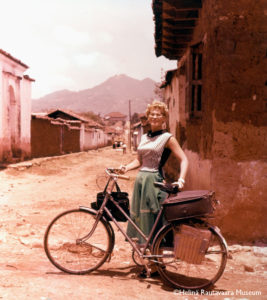
 In 1958 Rautavaara received an ASLA-Fullbright scholarship to pay for her post graduate studies at the Ann Arbor University of Michigan, USA. This is also when she started long-distance cycling. Although Helinä was dating a medical student named Larry in the United States, her will to see the world was far more intense than her will to settle down. Following her vocation to explore, in the year 1960 she decided to take up a cycling journey through from Mexico through Central America to South America. She certainly did not have the light-wear gear of modern days for doing so, yet, by then again, by the looks of it, Ms Rautavaara was more concerned about her appearance than about having the most comfortable, multi-use clothes for cycling. In fact, it’s said that she used to cycle in a cocktail dress, in order to be ready for every occasion. (Me and my horrid cycling outfits definitely have a lot to learn from her!)
On this long-distance cycling trip, Helinä met a vast amount of artists and other important people in the countries she visited. In Mexico, she was taken to visit the Mayan ruins. In Central America, she had a chance to discover the indigenous rituals of the people living in the mountains, as well as the traditional, European style dances of the Atlantic coast. In Colombia, Rautavaara met up with the guerrilla leader Chispas and wrote an article about him for a Finnish magazine. About her trip in Bolivia, she commented the following: “In every village there is a different Saint. You have to know when and where that Saint is celebrated and go there nine days earlier. That’s when the festivities start.” During her trip, Rautavaara compiled various programs for the Bolivian national broadcasting company.
Although her parents were continuously worried about her travels outside Europe, Helinä herself has was never afraid. In fact, according to her, an individual was respected so much everywhere in the world that she always felt welcome wherever she went. This is an important notion, as these were times without the possibility of searching for information on the internet or the option of checking out maps on a smart phone. As a long-distance cyclist myself, I can’t help imagining what it must have been like in the 50s and 60s.
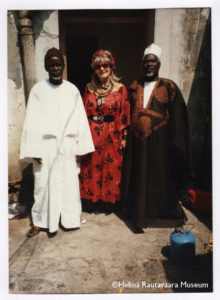
 In the years 1963–1964 Rautavaara visited Brazil and was overwhelmed by the cultures of candomblé and capoeira. During this trip she started collecting material on Afrobrazilian religions for her doctoral thesis and an interest for Africa was awoken. In year 1966 Helinä went for the first time to Western Africa and attended the UNESCO cultural colloquium of Africa and Latin America. From there, she continued on to Benin and Senegal, where she attended a month long arts festival. This festival was a meeting point for the people from the African cultural circle, and according to Helinä herself, during this month she learned more about African cultures than she ever had until then. This festival was also where she met for the first time His Imperial Majesty Haile Selassie. In years 1970–1971 Helinä did another trip to Brazil, during which she visited such religious places where people outside these specific religions were usually not welcome.
In the years 1973 and 1974 Rautavaara visited East Africa and met, for example, Idi Amin in Uganda. There, she expressed her will to discover more about the traditions of the old royal families in Uganda and so she ended up visiting many local tribes. In the years 1976 and 1986 she visited Ghana to take pictures of different tribes and rituals, and in year 1976 she went back to Nigeria to investigate the origins of the Brazilian Afro cultures. To Senegal she returned ten times from year 1984 and to Egypt twice. Eventually, Helinä Rautavaara became a doctoral student of newly founded department of comparative religion of the Universtity of Helsinki. Trom there, she applied for grants for studying the Brazilian and Jamaican religions.
In the year 1980 during her travels to London and New York, Helinä got acquainted with the Rastafari movement. According to her own words, she was drawn into the movement because of her interest for Africa. Rautavaara was initiated into the rasta religion, and made herself known as the “white rasta”, Ras Benjamin. In year 1981, on a six-month stay in Jamaica, she explored Jamaican syncretist religions, visited local rasta communities and met several reggae musicians. She filmed and recorded the rituals of the rasta (e.g. the 50th celebration of the coronation of Haile Selassie). She was also present at the funeral of Bob Marley in Kingston on May 21st 1981. In 1991 Rautavaara made her first important trips to the Dominican Republic and Haiti. The materials collected in the latter ended up being the core of Helinä’s first museum.
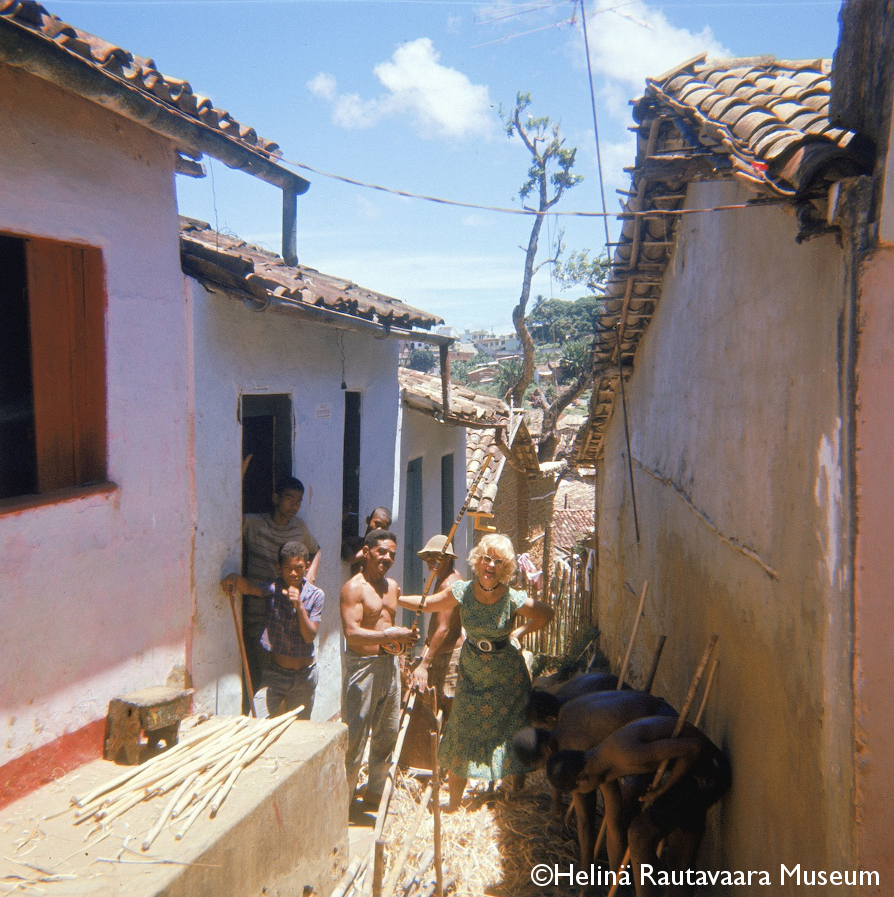 In 1991 Helinä opened a private museum in a small apartment in Töölö, Helsinki. The core of this Baga-Zombie museum were objects collected during a short visit to Haiti. In addition to this, there were articles from various Buddhist, Mexican and West African traditions, to which Helinä used to connect exhilarating stories about their origins. Objects were never just objects to her, but rather important parts of cultures and rituals.
Later on, Helinä rented out more room for her museum in an apartment space nearby. In order to insure the future of the collections, in 1997 she started a foundation with representatives from the city of Espoo, from the Finnish Anthropological Society, the University of Helsinki and the Finnish Museums Association. In 1998 the objects were removed from Helinä Rautavaara’s home to the premises of the WeeGee complex in Tapiola, Espoo, only a few months after Rautavaara’s death.
The Helinä Rautavaara Museum boasts with a large collection of objects from five different continents. More accurately, it hosts 3000 objects and an approximately similar amount of photos, film and audio materials. The curious aspect of the museum is that it’s not just an anonymous collection of objects from here and there, but originates from the life and stories of one hell of a characteristic and bold woman. Whist originally being based solely on the trips and experiences of Helinä Rautavaara herself, today the museum stands out formuch more than this. For the past 18 years it has strived towards creating an important national and international network of actors and collaborators, just like the one Helinä created in her times. The cross-disciplinary museum works with artists, researches, local immigrant communities and disadvantaged groups. Its main goals nowadays are global education, raising intercultural dialogue and awareness, and work against discrimination and racism.
In Finland, the museum is famous for its innovative audience work and for being an active social influencer. Each year, it runs several projects funded by the Foreign Ministry of Finland, the Ministry of Education and various independent foundations. The annual number of the visitors has been around 50 000 and the numbers of events organized more than 300. The museum is also a popular place for school visits.
The Helinä Rautavaara Museum has reopened in a new location (Ahertajankuja 4, Espoo)
For more info, visit: www.helinamuseo.fi
Facebook: Helinä Rautavaaran museo
All information about Helinä Rautavaara provided by: www.helinamuseo.fi.
So, what is it that me and Helinä have in common if not the outfits (although I, too, am a fan of animal patterns just as she was)? Well, just as Helinä’s, my father is a professor who has always hoped on me having something sensible to do. Just as hers, my mother keeps sending me detailed advice in letters on what to do, no matter where I am. As Helinä had a summer job in Sweden, I had a summer job in Italy. After school we both left to hitchhike with our partners and later on our own for vast amounts of time. Just as her, I also studied at the Department of Comparative Religion at the University of Helsinki. We have both have worked for the radio, tv and magazines. We both love different cultures and getting to know people. We both love writing. And last but not least, we have both undertaken a cycling trip alone through Latin America!
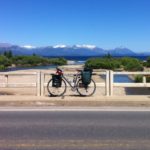
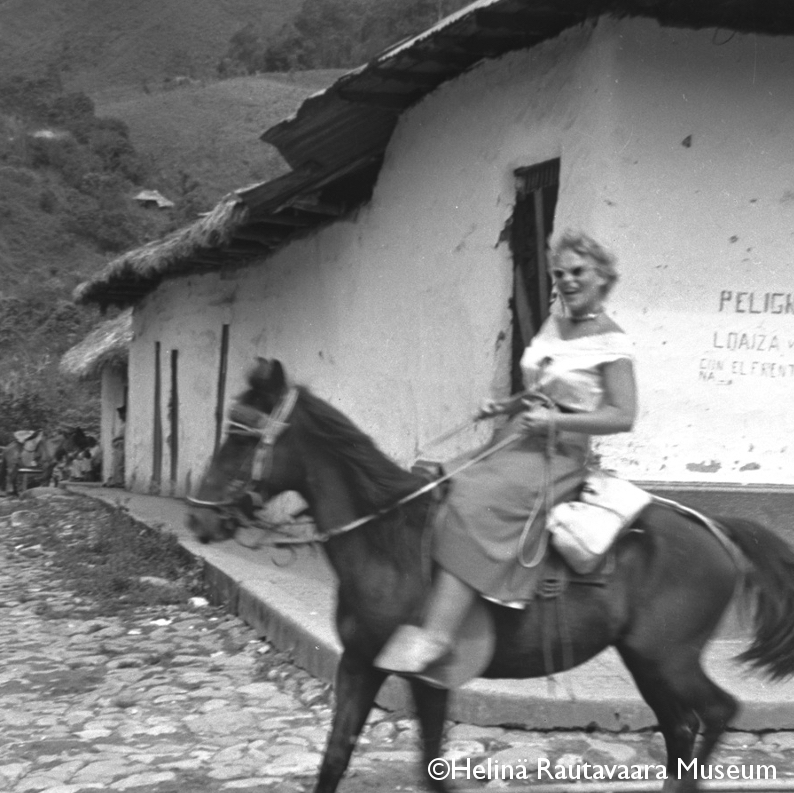 I will be visiting some of the places (e.g. Salta and Quito) Helinä Rautavaara visited on her cycling journey through Latin America in the 60s. Circumstances allowing, I’ll also write entries connected to Rautavaara’s experiences in those places, whilst comparing them to my own. I’m curious to see how the world and its people have changed over the years, and how I’ll perceive the things a countryman of mine discovered already half a decade ago. Are you?

Comments are closed.


Great!
Thank you! It’s impossible to write a boring post about such a colorful person!
woah. she’s totally amazing.
Hi Tara!!! I know! I was so inspired the first time I heard about her. If you ever visit Finland on your journeys, don’t miss out on her museum. It’s lovely!